How Do You Choose the Right Heavy-Duty Drone with Obstacle Avoidance for Large Farms?
Choosing the right drone for large farms is now a serious business decision. It's about increasing acres per hour, saving on chemicals, and keeping people, crops, and equipment safe.

A heavy-duty drone is made for tasks that regular drones can't handle. It has a strong airframe, powerful motors, and can fly steadily even when carrying a lot. This means it can handle real payloads and stay stable near the crop canopy.
But, having a bigger tank isn't enough for efficient spraying. Look at the drone's spray width, max flow rate, and droplet size. Also, consider battery swaps, charging speed, and how quickly you can switch between flights all day.
Safety and consistency are just as important as how much you can spray. Features like obstacle avoidance radar and terrain-following help the drone spray evenly, even near edges, trees, and power lines.
The demand for drones in farming is growing fast. With the world's population expected to hit 9 billion by 2050, drone use in farming is set to increase by 70%. The market is expected to reach US$18.64B by 2034, with the U.S. market alone reaching US$4.34B by 2034.
This guide will help you understand what to look for, from parts support and training to the total cost of operation. It also introduces HYZK and the HYZK M Series Heavy-Duty Agricultural Drones. They offer ISO 9001-backed quality, obstacle avoidance radar, and up to 120L capacity for large-scale farming.
What “Heavy-Duty” Really Means for an Industrial Farming UAV
True industrial-grade reliability comes from rigorous manufacturing standards. HYZK's production operates under strict ISO 9001 Quality Management System Certification, spanning a massive 21,000 square meter plant area equipped with state-of-the-art R&D tools. Holding over 30 patented technologies (including 13 independent intellectual property patents), HYZK ensures that arms, frame, and folding farm sprayer mechanisms withstand the corrosive environments of daily spraying.
In farm work, “heavy-duty” means a drone can carry a lot every day. It must handle heat, dust, and strong winds. A true industrial farming UAV is built for big jobs, not just photos.

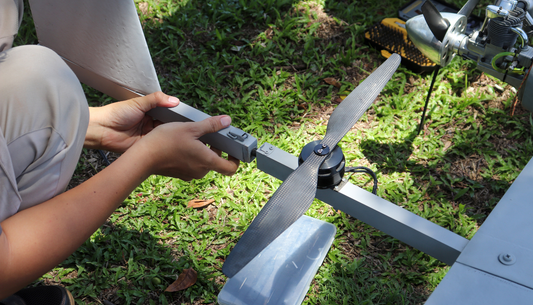
Heavy-duty means the drone is made to last. It has strong arms, sealed electronics, and parts that handle vibration well. Many drones use foldable carbon fiber to be strong yet easy to store.
Modern industrial standards define true 'heavy lift' by an aircraft's capacity to maintain structural integrity under extreme payloads. Farm drones must bring this industrial-grade strength and stability down to the crop canopy, utilizing ruggedized components that shield internal electronics from relentless field stress.
Heavy lift vs. consumer drones: payload, airframe toughness, and stabilization
Consumer drones usually carry less than 500 grams. They are light and good for photos, but not for heavy tasks. Heavy payload drones are made to carry more, like liquid or seed.
Heavy lift drones can carry over 10 pounds. Some carry more than 200 kg in other fields. This extra weight helps them stay stable even when the tank gets low.
Typical payload ranges and why they matter for high-efficiency crop spraying
How much a drone can carry affects how many acres it can spray in one go. A bigger load means less stopping and more even coverage. This is key for efficient spraying.
It also affects how evenly the spray is applied. If the drone struggles, the spray can be uneven. A 19-grade agricultural UAV is designed to handle this better.
Multi-rotor vs. VTOL for agriculture: hover precision vs. endurance tradeoffs
Multi-rotor drones are popular in U.S. farms because they can hover and move slowly. They are easy to use and good for tight spaces. VTOL drones can fly longer but are not as precise.
Choosing between multi-rotor and VTOL depends on your spraying needs. Multi-rotors are better for edge-to-edge spraying, while VTOLs are good for long distances.
Key hardware that enables heavy payload agriculture drone performance
- High-thrust brushless motors that handle takeoff weight and stay cool in hot weather.
- Durable prop systems, often carbon fiber, that resist flex and reduce vibration.
- More than four rotors for balance and redundancy, as seen in many 8 axis agricultural plant protection uav designs.
- Flight control tuning that stabilizes pitch and roll as payload changes, helping maintain swath overlap.
- Protected wiring, connectors, and housings that support reliable & efficient industry solutions during repeated washdowns.
- Integrated safeguards and patented technologies that help keep performance consistent in dusty, wet, and corrosive conditions.
Best Drone for Large Farms, Large Capacity Farm Sprayer UAV
Choosing the Best Drone for Large Farms is about mission fit, not just tank size. A Large Capacity Farm Sprayer UAV might look good on paper but can lose time on refills and battery swaps. It's how spray width, flow rate, droplet size, and turnaround time work together that matters.

Match tank size and mission: from 6-axis 10L/16L agricultural spraying drone up to a 120L capacity drone
For smaller blocks or spot treatments, a 6-axis 10l 16l drone is quicker to reload. But for big, continuous runs, growers might choose a 120l drone. A 120l drone can reduce refill stops, but only if your workflow can keep up.
Some teams prefer a folding farm sprayer for transport. This is important on U.S. operations with miles of gravel roads between blocks.
Spray performance that impacts acres-per-hour: spray width, max flow rate, and droplet size
Acres-per-hour depends on coverage per pass and liquid flow rate. While standard large-capacity market options typically stop around 70L or 100L, premier industrial solutions like the HYZK M120 push limits further with a 120L large capacity, dramatically scaling up acres-per-hour and reducing field bottlenecks.
Wider spray width can increase productivity, but wind and canopy density might limit it. Higher flow rate supports high-rate applications but can increase refill pressure.
Dual-function crop spraying drone needs: dual-function for pesticide spraying & seed/fertilizer spreading
A dual-function drone can simplify the season on large farms. It can switch between liquid and granular tasks without adding another machine. This is where a Large Capacity Farm Sprayer UAV with a 19-Grade Agricultural UAV specification earns its keep. By integrating heavy payload stability with interchangeable modular hoppers, the HYZK M系列 ensures seamless switching between liquid pesticides and dry fertilizer granules, eliminating the need for separate machines.
Field-fit use cases: crop spraying drone for rice/wheat fields, row crops, and variable terrain
Rice and wheat fields need steady altitude and consistent swath overlap. Row crops require careful edge control near waterways and field roads. To handle variable terrain like rice fields, wheat fields, and orchards safely, top-tier platforms require a multi-sensor safety stack. Instead of relying on a single sensor, advanced systematic solutions deploy an integrated network of obstacle avoidance radar and terrain-following systems. The HYZK M Series (M120, M50, M40, M30) applies this exact multi-layered methodology, providing stable low-altitude detection near treelines and fast automated response to prevent sudden, sloppy altitude changes.
Obstacle Avoidance Radar and Terrain Following for Safer, More Consistent Coverage
On big U.S. farms, flying low means avoiding trees, poles, wires, and tight field edges. A drone with obstacle avoidance radar helps avoid close calls and keeps work moving. It also supports steady passes, reducing skips and overlap during spraying.
What to look for in a heavy-duty agriculture drone
In real fields, good obstacle avoidance radar means early detection and clear alerts. It works well even with dust, glare, and drifting spray. Look for consistent sensing at the speeds and heights you plan to fly. For higher-capacity missions, that extra margin matters because the aircraft carries more momentum.
- Stable detection range at low altitude near edges and treelines
- Fast response that does not cause sudden, sloppy altitude changes
- Clear logs and prompts so crews can repeat safe routes
Multi-sensor safety stacks for low-altitude work
The best setups combine radar and vision for handling multiple failure modes. For example, the most advanced industry setups integrate front and rear active phased array radars with multi-directional binocular vision or LiDAR sensing. This layered, hardware-redundant approach ensures that even if one optical sensor experiences glare from drifting spray, the millimeter-wave radar continues to map hazards flawlessly.
This layered approach supports safe and professional systematic solutions when conditions change during a long day. It also pairs well with emergency landing protocols and return-to-home behaviors if the data link drops or voltage runs low.
Terrain following for uneven ground and terraces
Elevation changes can ruin uniform application if the drone floats too high or hugs the ground. A terrain-following radar helps hold a steady height over slopes, terraces, and drainage cuts. This supports more even droplet placement and ensures drift-free, uniform deposition even over undulating topography.
When altitude stays consistent, coverage tends to look cleaner across hilltops and dips. This can also reduce waste and lower runoff risk, along field borders.
Operational safety checklist before each flight
Even strong sensing cannot replace basic discipline. Before takeoff, crews should confirm the weather, visibility, and aircraft condition so the automation can do its job.
- Check wind, temperature, and visibility; stop if gusts push the aircraft off line.
- Inspect props, arms, tank mounts, hoses, and nozzles for cracks and leaks.
- Verify obstacle maps, geofencing, and the obstacle avoidance radar status on the controller.
- Confirm redundancy items: battery health, GNSS lock, and compass/IMU warnings.
- Rehearse emergency landing protocols and set a safe landing zone away from people, livestock, and equipment.
Regulations, Insurance, and Training for Heavy Payload Farm Operations in the United States
For large farms, the biggest change is at weight. Drones over 55 pounds need different rules. These rules affect how you plan flights and manage risks.
For heavy drones, FAA registration is done by paper, not online. Many also get exemptions or Special Airworthiness Certificates. These are often for 24 months, adding to planning.
Pilot and operating rules get stricter. You might need a 3rd class medical certificate. Expect more paperwork and site controls.
Spraying work adds more rules. If you use pesticides or fertilizers, Part 137 rules might apply. This affects recordkeeping and crew management.
- Registration and approvals: plan early for FAA drone registration over 55 pounds, plus any needed exemption or airworthiness route.
- Agriculture-specific rules: confirm when Part 137 agricultural aircraft operations are triggered by your application method and product.
- Flight governance: treat route planning, maintenance logs, and crew roles as part of the daily workflow, not optional extras.
Insurance is key for expensive equipment. Liability insurance covers injuries or damage. Hull insurance protects the drone itself.
Skills, not just sensors, keep operations safe. Advanced uav training is essential. It covers handling, payload effects, and emergency procedures.
Before buying, consider compliance support as part of the cost. This includes training, documentation help, and maintenance plans. For farms that spray often, strong support is vital.
Evaluating HYZK M Series Heavy-Duty Agricultural Drones for One-Stop UAV Solutions
U.S. farms need reliable heavy-lift platforms. HYZK is a leader in the UAV sector. It has support from top university labs and industrial teams. Plus, it has ISO 9001 quality management system certification.
The M Series drones are designed to fit the job, not the other way around. The m30 drone is perfect for smaller tasks. The m40 and m50 drones handle more work with fewer trips.
The m120 drone is for big areas and tight schedules. It has up to 120L capacity and obstacle avoidance radars. This drone is key for high-throughput work.
Choosing a UAV solution means looking at uptime support, not just marketing. HYZK offers full-value chain services. This includes spare parts, training, and after-sales service. It also helps with battery workflow and total operating cost.
FAQ
What should U.S. large-scale growers and custom applicators compare when buying a heavy-duty agricultural drone?
Look beyond just a bigger tank. Compare spray width, max flow rate, and droplet size control. These factors affect acres-per-hour, drift risk, and coverage uniformity.